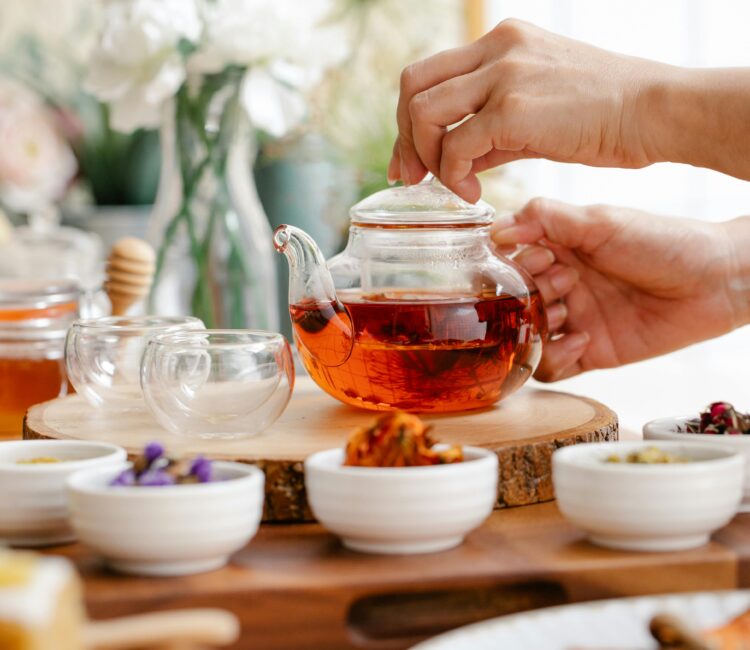
I often say that herbalism is my first language of care, but what I really mean is that it’s the language my body and spirit understood long before I found words for the things I felt. When I was little, summers in the country meant long days filled with the scent of earth and sun-warmed leaves. My Ma would call me over to help gather herbs for dinner — a few sprigs of dill, a fistful of parsley, sometimes a little mint if the air felt heavy. I remember the feeling of brushing past tall grasses, the hum of insects, the simple joy of carrying those green bundles back to her. I didn’t know it then, but those small rituals were teaching me to listen to plants in a way that stayed with me.
Before I knew the names of plants, I knew the comfort of them.
Before I could speak about health, I understood what it meant to be held by a warm cup, a familiar scent, a small ritual that made the world feel a little softer.
Before I studied clinical herbalism, I practised the quiet, instinctive kind — the kind that comes from simply paying attention.
Herbalism came to me the way a mother tongue does: not through memorisation, but immersion. It wasn’t a conscious choice so much as a slow remembering.
Growing Up With Plants as Companions
Like many people with folk roots, plants were never separate from my daily life. They were in the kitchen, in the garden, in seasonal traditions, in the stories my family told, without realising they were passing on generations of herbal knowing.
We didn’t call it herbalism.
It was just… what we did.
Warm teas for colds.
Onion syrup for a scratchy throat.
Nettle in the spring for strength.
Lemon Balm for frayed nerves.
Rituals woven quietly into ordinary living.
It felt as natural as breathing.
Finding Herbalism Again Through Illness
As I grew older and began navigating life with disability, herbalism became something deeper — not just familiar, but foundational.
I found myself returning to plants in the moments when my body felt unpredictable, when I needed grounding, when the world felt too sharp and too fast. Sometimes that meant brewing willow bark or turmeric when pain arrived out of nowhere, letting the warmth remind me I had options. Sometimes it meant pausing with a simple cup of green tea to feel my feet on the ground again. And on the overstimulating days — the ones that felt bright and brittle around the edges — lemon balm became a soft place to land. Herbalism gave me something both practical and empowering: a way to participate in my own care, even on the days I felt limited.
It wasn’t a miracle cure.
It was something gentler and far more sustainable: a relationship.
A way of listening to my body instead of fighting it.
A way of offering comfort to myself when nothing else seemed to fit.
A way of remembering I wasn’t fragile — just human.
Plants helped me piece together a sense of agency. A sense of rhythm. A sense of belonging.
The Bridge Between Folk Wisdom and Science
As I deepened my studies, I realised the medicine I grew up with had always been both folk and scientific — I just didn’t have the terminology yet.
Now, through clinical herbalism training, I’m learning the structures beneath the intuition: the actions, constituents, energetics, contraindications. The things that help me practice safely, effectively, and responsibly. Part of that work is staying mindful of safety — checking for contraindications, being aware of herb–drug interactions, and knowing when home remedies need to give way to medical care.
However, the heart of my practice remains unchanged.
It’s still rooted in tradition, in connection, in the belief that care doesn’t have to be complicated to be meaningful.
I’ve always felt that herbalism is the meeting place between what we inherit and what we learn — the old stories and the new research, the intuitions and the evidence. A bridge rather than a divide.
And that bridge is exactly where Herbata Haven lives. If you’ve found your own meeting place between tradition and science, I’d love to hear how plants have shaped your path, too — maybe a remedy you learned from family, a tea you return to again and again, or an herb that feels like an old friend.
Herbalism as Relationship, Not Remedy
When I talk about herbalism as a language of care, I don’t just mean caring for others — though that’s a huge part of it. I also mean caring for myself in a way that feels sustainable, accessible, and deeply respectful of my needs.
Care that meets me where I am.
Care that adapts as I do.
Care that doesn’t demand I be any version of myself other than the one that exists in the moment.
Herbalism, at its essence, is relational.
It’s slow, seasonal, and reciprocal.
It teaches patience, humility, and presence.
It reminds us that resilience isn’t about hardening — it’s about tending.
Why I Built Herbata Haven
Herbata Haven began as a small promise to myself: to create a corner of the world where herbalism felt approachable, grounded, culturally rooted, and human. A place where others could feel the same comfort and curiosity that carried me through difficult seasons.
I wanted to share my experience with herbalism — not as a rigid set of rules, but as a lived, evolving practice.
Part folk wisdom.
Part science.
Part personal ritual.
Always sincere.
Herbalism taught me how to care — gently, consistently, creatively.
And now I’m simply passing that language on in the hope it resonates with someone else.
A Final Word
If you’re here, reading this, you’re already part of this little haven. I hope you’ll wander through it at your own pace, noticing which plants or practices speak to you — and in whatever way feels right for your body, your background, and your lived experience. Herbalism meets each of us differently, and there’s room for all of those stories here.
I’m so grateful to walk this path together — rooted in tradition, grounded in knowledge, and guided always by care.
Herbalism may have been my first language of care,
However, it is the community that keeps it alive.
With seeded gratitude,
Herbata Haven
STAY CONNECTED WITH NATURE
“In every leaf, a remedy. In every remedy, a story.” 🌿
LEAVE YOUR COMMENT
Your email address will not be published. Required fields are marked *